
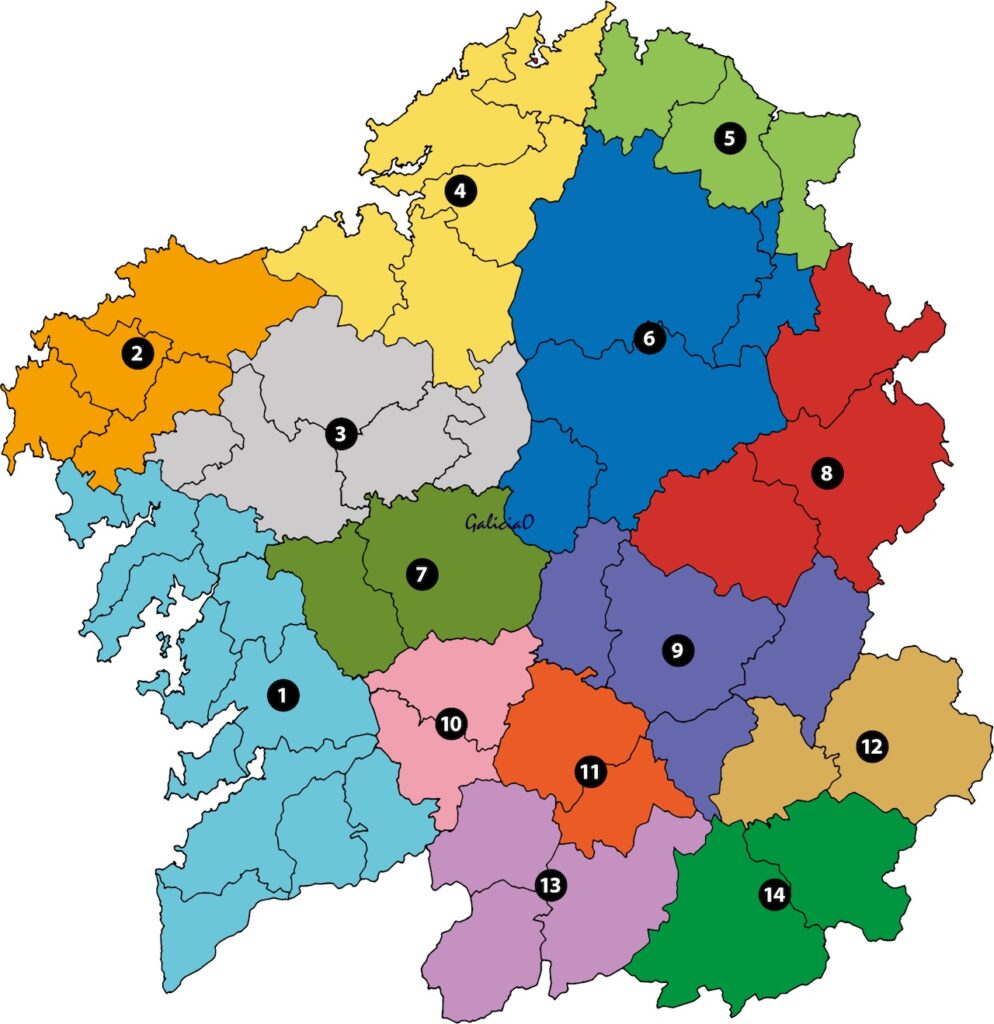
Galicia is in the northwest of Spain, next to the Atlantic Ocean and north of Portugal. Its rivers, cities, and inland landscapes offer very different routes: this map will help you locate them.
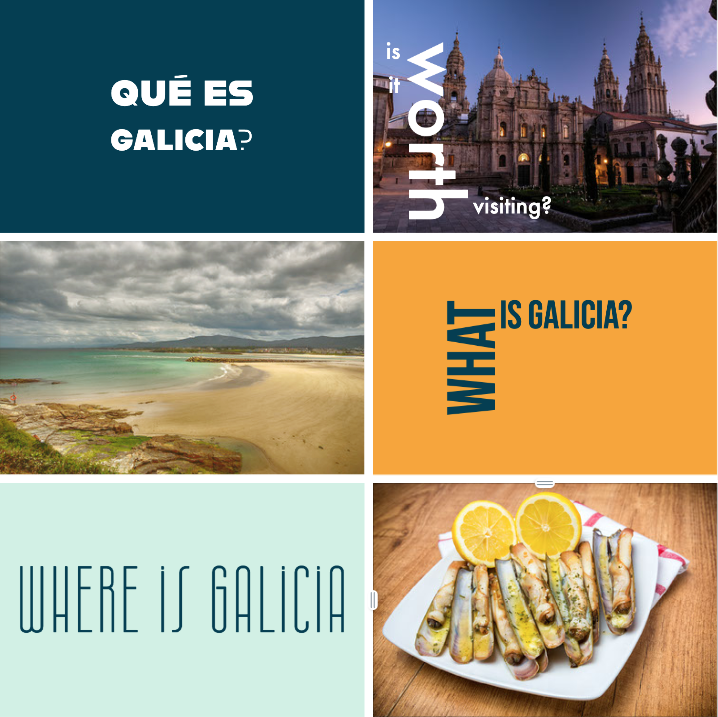
What is Galicia? Where is Galicia?
Galicia is one of the 17 Autonomous Communities that Spain is divided into. An Autonomous Community is a geographical region that shares history and traditions, meaning it has an independent identity, and it also has its own government. Some are uniprovincial, while others, like Galicia, are multiprovincial. This autonomous government has authority over very important matters, such as Health or Education, and also Tourism (among others).
Galicia is located in the northwestern part of the peninsula, just above Portugal, and is divided into 4 provinces, whose capitals share the same names: A Coruña, Lugo, Ourense, and Pontevedra. The capital of the Autonomous Community is not one of these, but Santiago de Compostela. The whole community has 2,700,000 inhabitants, and two official languages coexist: Spanish and Galician.


Why travel to Galicia?
First of all, if you come from outside Spain, you should also consider getting to know the Northern Peninsula. Why? Because Spain has two different landscapes and historical legacies. In general terms, we can talk about a north with green landscapes and Christian legacy; and a south with ochre landscapes and Muslim legacy.
International travelers often choose Madrid, Barcelona, and the main Andalusian cities (Córdoba-Granada-Sevilla), which is certainly a valid choice. However, the reality and landscapes of the north are quite different. As a result, they carry away a somewhat skewed understanding of Spain.
A video by Dennis Schmelz
Now then, since there are several communities in the North, why visit Galicia?
For its history.
"Europe was made pilgriming to Compostela"
This phrase is attributed to Goethe, German poet, playwright, and naturalist. Following the discovery of the tomb of the Apostle James the Greater in the 9th century, thousands and thousands of pilgrims traverse Europe to reach Santiago de Compostela. At that time, Muslims occupied almost the entire peninsula.
However, through the Camino, great religious orders, some of them also military, established themselves along this route, modifying societies and economies. They built monasteries and churches to welcome pilgrims, worked the land, and provided medicines. At the same time, kings and lords constructed bridges to help pilgrims cross rivers, hospitals, and roads. Pilgrims prefer routes with more services, thus new populations emerge with services alongside the Camino de Santiago.
The contribution of the Camino to the history and morphology of the north is undeniable, not only of Spain but also of Europe. Santiago is the goal of all pilgrims and the capital of Galicia. To overlook a visit to Galicia is to overlook an important part of the history and culture of the country.
For its landscapes. Because Galicia is unmissable.
But there's more. The setting of this story is spectacular. Galicia has an irregular coastline 1,200 km long, forming rivers, bays, cliffs, estuaries, and beaches. A paradise. There are more than 800 beaches and coves, dreamlike forests, and mountains that soften as they approach the sea, and water in various forms. Rivers, sea, rain, fog, ice, snow, and dew.
If there are two colors that define Galicia, they could be green, in as many shades as you can imagine, and gray, from the granite and the sky. For these landscapes, for its traditions, for its food, and for its people, Galicia is a must-visit destination. Hold on to the images that speak more than a thousand words.
What areas are there in Galicia?
Touristically, Galicia is divided into several areas that share the same characteristics:
- Rías Baixas, which in turn is divided into Ría de Vigo and Bajo Miño, Ría de Pontevedra, Ría de Arousa and Ría de Muros and Noia.
- Costa da Morte
- Tierras de Santiago
- Rías Altas, which is divided into A Coruña and Ferrolterra.
- Mariña Lucense
- Lugo and Terra Chá
- Deza- Tabeirós
- Ancares-Courel
- Ribeira Sacra
- O Ribeiro
- Terras de Ourense and Allariz
- Manzaneda-Trevinca
- Celanova-Limia
- Verín-Viana
If you want to see road trips or itineraries for Galicia, click here.
If you want to see how much does it cost to travel to Galicia, follow this link.